Raman Microscopy Applications in Kidney Health Preservation

Raman Microscopy Applications in Kidney Health Preservation
Introduction
Urinary stones and kidney diseases represent a significant global health issue, with crystals serving as key diagnostic indicators for both urinary system stones and kidney damage. The causes of urinary tract stones are multifaceted, closely linked to metabolic abnormalities. By analyzing the composition of urinary stones, it is possible to identify metabolic risk factors, which play a crucial role in understanding the underlying causes of stone formation and in preventing their recurrence. Therefore, this study focuses on the identification and analysis of urine crystals using Raman spectroscopy technology, aiming to enhance the diagnosis of urinary system stones and kidney damage. Notably, even within the same province, there are regional differences in the prevalence of urinary stones and kidney disease. Investigating immutable factors such as gender, age, race, and genetics in regional populations can provide valuable insights for the screening and early intervention of urinary stone diseases. This research also highlights the role of regional environmental factors, dietary habits, and other modifiable elements, offering a theoretical foundation for preventive measures to reduce stone recurrence and to guide local health policies.
Background
The incidence of urinary system stones in China ranges from 1% to 5%. In recent years, significant advancements have been made in both the basic research and clinical treatment of urinary stones. Different types of urine crystals hold distinct diagnostic significance in clinical practice. Traditionally, urine crystal detection relied on chemical reagents and microscopic examination, methods that are labor-intensive, resource-consuming, and do not effectively preserve samples. However, with the rapid development of Raman spectroscopy, urine crystals can now be rapidly identified and classified with greater accuracy, offering a more efficient and reliable diagnostic tool.
Instrument introduction
As the leader of domestic Raman products, aiSPEK's independently developed RM6100 series combines the advantages of microscopes and Raman spectrometers. The micro-Raman detection platform makes it possible to "what you see is what you measure". The observer can detect the Raman signals of different surface states on the sample, and can simultaneously display the micro-area morphology of the detected position on the computer, which is greatly convenient. Raman micro-area detection.
RM6100 is equipped with an objective lens specially designed for the Raman system, which makes the laser spot close to the diffraction limit. The focus information is accurately and intuitively displayed on the computer through a 3-megapixel camera, overcoming the slightly higher focal plane of ordinary Raman systems for collecting Raman signals. is smaller than or slightly below the actual optimal focal plane, thereby improving the quality of the Raman spectrum.
RM6100 has no moving parts for optical path switching. All optical components are solid-state assembly and work very stably. It perfectly solves the loss of light path during camera imaging and realizes the separation of camera imaging and Raman signal collection, thereby obtaining the best signal strength.
The picture uses Raman spectroscopy, a spectrum that reflects molecular vibration and molecular rotation. It is essentially a characteristic frequency shift that is generated by the interaction between molecules and photons and represents the energy level difference of molecular vibration or rotation. Raman frequency shift uses Raman spectrum to perform structural analysis and property detection on the molecular level of the substance. Based on the Raman spectrum, the structure and chemical properties of the molecule are judged, and the specific molecular categories or components are obtained, so as to conduct urine crystallization. Rapid identification and analysis.
Test Results
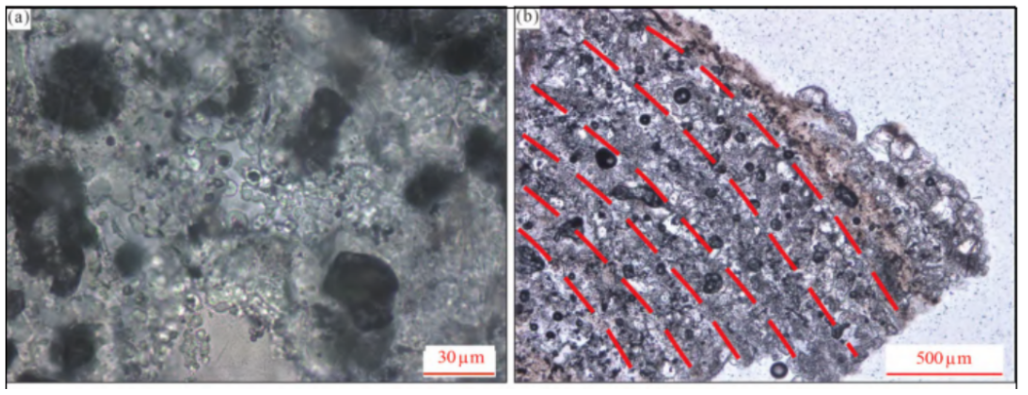
A: Microscopic stone picture 1 B: Microscopic stone picture 2
RM6100-1064 test result spectrum

Picture 1
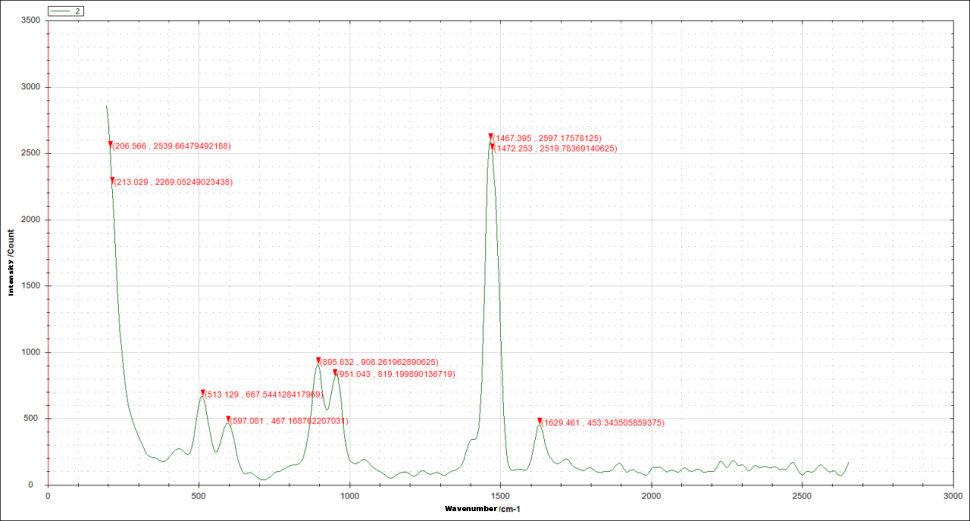
Picture 2

Conclusion
Referring to the results of previous Raman spectroscopy studies on urinary tract stones, the vibration mode of oxalate stone is more complex than that of phosphate, containing multiple strong characteristic peaks. The frequencies of different vibration modes on the Raman spectrum are mainly in the range of 400~1800cm-1 , including the symmetric stretching vibration mode of the carboxylate group frequency in the range of 1400~1550cm-1 and the asymmetric stretching vibration mode in the range of 1550~1700cm-1, as well as the C-C symmetric stretching vibration mode in the range of 850~950cm-1 and the The range of 450~550cm-1 belongs to the O-C-O plane bending vibration mode β (O-C-O). In addition, the molecular structure of oxalate will vary due to different crystal water content, which will lead to differences in its Raman characteristic spectra. There are obvious differences in the Raman spectra of colemanite monohydrate and colemanite dihydrate, which are common components in urinary tract stones. Calcium oxalate monohydrate has vibrational double peaks at 1467cm-1 and 1490cm-1, a peak at 1629cm-1, and a (C-C) peak at 895cm-1.
This test study shows that the material composition of infectious stones is mainly composed of calcite (calcium oxalate monohydrate/calcium oxalate dihydrate), which shows that infectious stones are significantly heterogeneous and contain a small amount of struvite and carbon apatite. The causes of stones and diseases are closely related. The types and morphological characteristics of the minerals in the stones were obtained, and combined with crystallographic and mineralogical theories, we preliminarily identified the mechanism by which the formation process of stone minerals is constrained by the human body fluid environmental system and crystal habits. It is completely helpful to understand the environment in which stones form and explore the causes of stones.
RM8000 Rapid Test For Respiratory Diseases With High Incidence In Winter