IR Spectroscopy: The "Fingerprint" Technology for Molecules
IR Spectroscopy: The "Fingerprint" Technology for Molecules
Introduction
In the fields of chemical analysis and material characterization, there exists a technique that can "see" molecular vibrations—much like taking fingerprints of molecules. This is infrared spectroscopy (IR). Whether identifying unknown compounds or monitoring chemical reaction processes, IR spectroscopy plays an indispensable role. This article will explore the principles, applications, and latest advancements of this remarkable technology.
What is IR Spectroscopy?
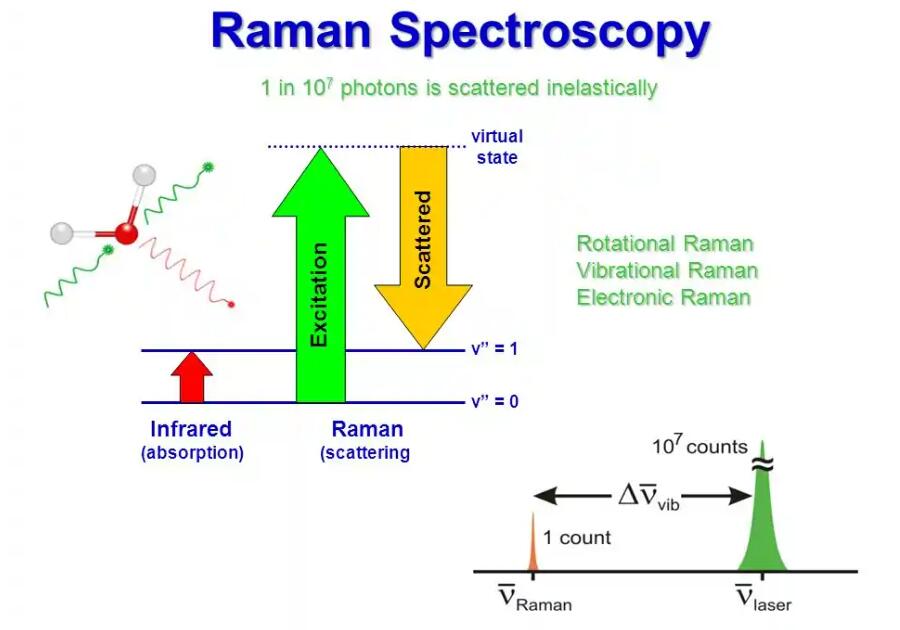
IR spectroscopy is an analytical technique based on transitions in molecular vibrational and rotational energy levels. When infrared light interacts with a sample, chemical bonds absorb specific frequencies of IR radiation and begin to vibrate. By measuring these absorptions, we obtain a "molecular fingerprint"—the IR spectrum.
Infrared light refers to electromagnetic waves with wavelengths between 0.78-1000 μm (wavenumbers of approximately 12,800-10 cm⁻¹), situated between visible light and microwaves. In IR spectroscopy, the mid-infrared region (4,000-400 cm⁻¹) is most commonly used.
Working Principle: How Molecules "Dance" with Light
Atoms in molecules are connected by chemical bonds, which are not rigid but behave like springs that can stretch and bend. When the energy of IR light matches the vibrational energy level difference of a particular bond, it gets absorbed. Different chemical bonds (e.g., C=O, O-H, N-H) have characteristic absorption frequencies.
Key principles of IR spectroscopy:
- Dipole moment change: Only vibrations that alter the molecular dipole moment can absorb IR light.
- Energy matching: hν = ΔE (photon energy equals the vibrational energy level difference).
- Characteristic absorption: Each chemical bond/functional group has its unique absorption frequency.
Basic Components of an IR Spectrometer
Modern IR spectrometers typically consist of :
- Light source: Nernst glower or silicon carbide rod, emitting broad-spectrum IR light.
- Interferometer (in FTIR): Michelson interferometer generates an interferogram.
- Sample compartment: Houses the sample and supports various measurement modes.
- Detector: Converts light signals into electrical signals (e.g., DTGS, MCT detectors).
- Computer system: Controls the instrument and processes data.
Fourier-transform infrared spectroscopy (FTIR) has become the mainstream technology, offering advantages over traditional dispersive instruments, including faster scan times, higher sensitivity, and better resolution.
Sample Preparation Techniques
Different sample forms require different measurement approaches:
- Transmission mode: Solids (KBr pellets), liquids (thin films), gases (gas cells).
- Attenuated total reflectance (ATR): No sample preparation needed; directly analyzes solids or liquid surfaces.
- Diffuse reflectance (DRIFT): Suitable for powdered samples.
- Specular reflectance: Used for smooth surface analysis.
The widespread adoption of ATR technology has greatly simplified IR measurements, making IR spectroscopy accessible to non-specialists.
Interpreting IR Spectra
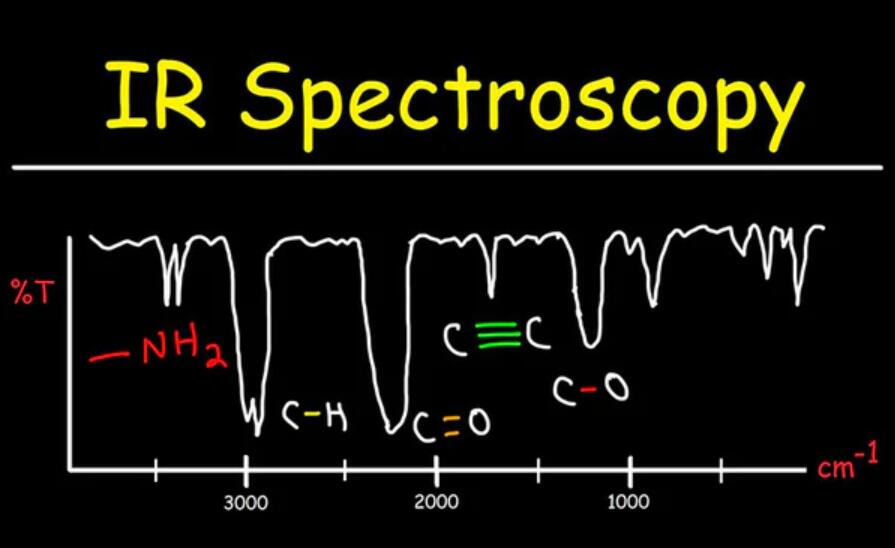
An IR spectrum typically plots wavenumber (cm⁻¹) on the x-axis and percent transmittance or absorbance on the y-axis. Key regions to examine:
Functional group region (4,000-1,500 cm⁻¹):
- O-H stretch: 3,700-3,200 cm⁻¹ (broad peak).
- N-H stretch: 3,500-3,300 cm⁻¹.
- C=O stretch: 1,850-1,650 cm⁻¹ (strong peak).
- C-H stretch: 3,000-2,850 cm⁻¹.
Fingerprint region (1,500-400 cm⁻¹):
Complex vibrational couplings used for compound identification.
Modern instruments often include spectral library search functions for rapid comparison with known compounds.
Applications
IR spectroscopy has diverse applications across multiple fields:
Chemistry & Pharmaceuticals:
- Active pharmaceutical ingredient identification.
- Reaction monitoring.
- Impurity detection.
Materials Science:
- Polymer characterization.
- Composite material analysis.
- Surface modification studies.
Forensics:
- Drug analysis.
- Paint, fiber, and other evidence examination.
Environmental Monitoring:
- Air pollutant detection.
- Water quality analysis.
Life Sciences:
- Protein secondary structure studies.
- Cell and tissue analysis.
Recent Advances and Future Perspectives
IR spectroscopy continues to evolve:
Hyphenated Techniques:
- IR microscopy (microspectroscopy).
- TGA-IR (thermogravimetric analysis coupled with IR).
- GC-IR (gas chromatography-IR).
Time-Resolved IR:
- Studying fast reaction kinetics.
- Femtosecond IR spectroscopy.
Quantum Cascade Laser IR (QCL-IR):
- Ultra-high sensitivity.
- Portable designs.
Artificial Intelligence Applications:
- Automated spectrum interpretation.
- Quantitative mixture analysis.
Conclusion
As a well-established analytical technique, IR spectroscopy remains fundamental in modern laboratories due to its simplicity, speed, and rich information content. With ongoing technological advancements, its applications continue to expand—from traditional chemical analysis to emerging biomedical fields. Understanding the principles and uses of IR spectroscopy provides researchers and industrial professionals with a powerful key to unlocking the molecular world.
The next time you see that unassuming IR spectrometer in the lab, remember it serves as a faithful "molecular interpreter," quietly recording the vibrational language of matter.
UV Fluorescence: The Invisible Glow in Nature
Transmission Measurement